"My son held a real piece of a meteorite in his hands and I have never seen him so lit up. Mr. Mark makes science feel like an adventure."
R
Renata F.
YSA parent
New Year Early Bird Bonuses only available until
See the bonusesScience, Nature & Space · Conceptual Science
Real specimens, live demonstrations and one connected story across chemistry, physics and beyond. Your kid makes a prediction, watches what happens and explains why.
From $44.22 /week
Course details
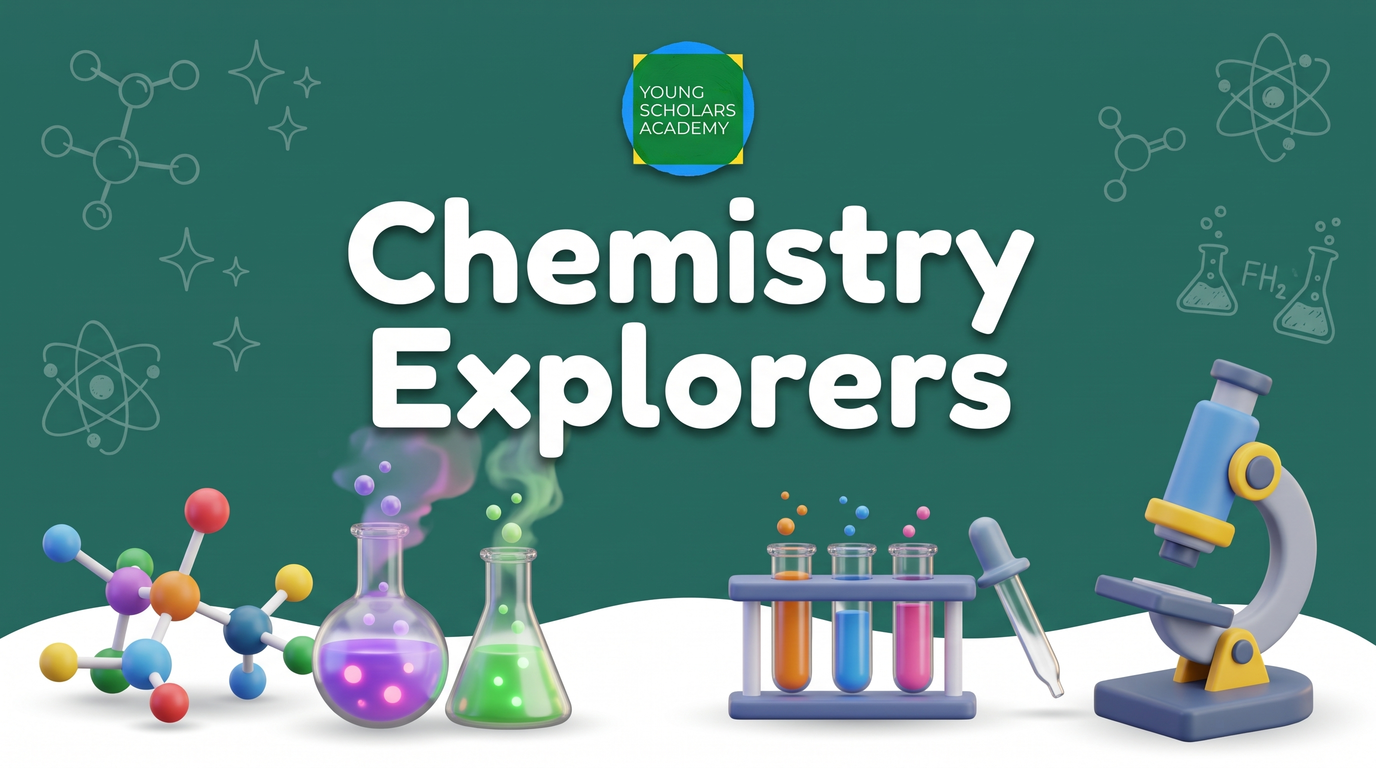
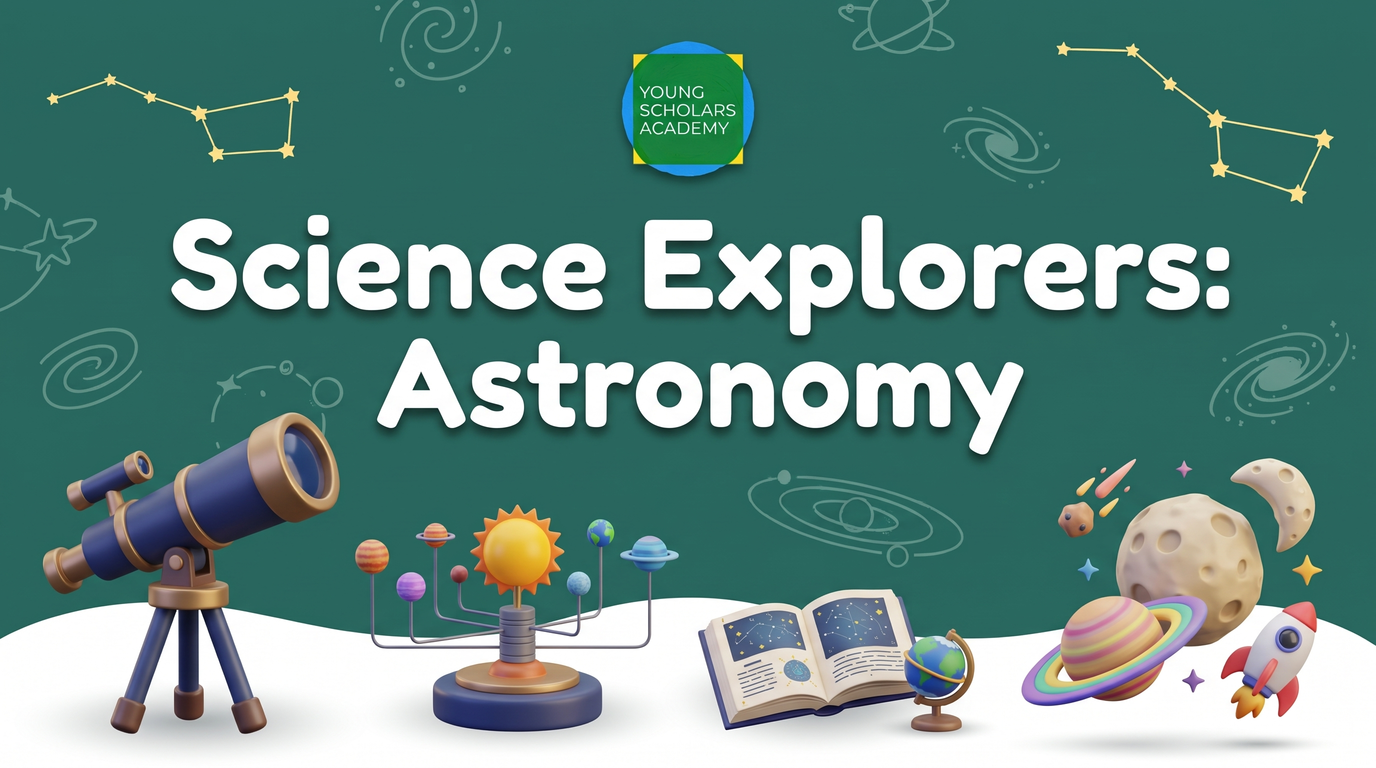
Young Scholars Academy's Science Explorers: Discovering Chemistry, Astronomy, Biology, and Anatomy is a live online science class for gifted or 2e students ages 9 to 18. Mr. Mark weaves chemistry, physics, astronomy, biology and the human body into one connected story, using real specimens and live demonstrations. Students predict, watch, look at the evidence and explain what happened, and no science background is needed to start.
Most science classes split the subjects into separate boxes. Science Explorers breaks out of that and weaves chemistry, physics, astronomy, biology and the human body into one story. Bright kids get to make the big connections between ideas. That keeps their excitement for science going.
Mr. Mark shares real specimens with the class, like meteorite fragments, lunar and Martian samples, megalodon teeth and dinosaur specimens. Students see the science up close and connect it to the world today. His classes are fluid and high-energy, and they make big ideas feel personal.
Every unit runs on predictions and evidence. Students make a prediction, watch the demonstration, look at the evidence and explain what happened. A wrong prediction counts as evidence too, and it leads to the next question.
Classes are small and live. Students can take part in the chat as well as out loud, cameras are optional, and a student can take a movement or quiet break when they need one.
WHAT PARENTS ARE SAYING
Parents don't just see happier kids. They see sharper thinking, stronger friendships, and a child who actually wants to log on.
"My son held a real piece of a meteorite in his hands and I have never seen him so lit up. Mr. Mark makes science feel like an adventure."
Renata F.
YSA parent
"Mr. Mark connects the stars to chemistry to biology in a way that finally made it all click for my daughter. She talks about his course at every dinner."
Grady M.
YSA parent
"The energy Mr. Mark brings is contagious. My reluctant scientist now begs to stay on after the session ends."
Priscilla N.
YSA parent
"Mr. Mark treats big ideas like cosmology and quantum physics as something kids can actually grasp. My son feels smart, not lost."
Tobias W.
YSA parent
"The energy Mr. Mark brings is contagious. My reluctant scientist now begs to stay on after the session ends."
Priscilla N.
YSA parent
"Mr. Mark treats big ideas like cosmology and quantum physics as something kids can actually grasp. My son feels smart, not lost."
Tobias W.
YSA parent
"My daughter used to think science was just memorizing facts. Mr. Mark showed her the universe is real and touchable, and she is hooked."
Yara S.
YSA parent
"Real lunar and Martian samples in a live online course. Mr. Mark somehow brought space into our living room, and my kids will never forget it."
Callum B.
YSA parent
"My son held a real piece of a meteorite in his hands and I have never seen him so lit up. Mr. Mark makes science feel like an adventure."
Renata F.
YSA parent
"Mr. Mark connects the stars to chemistry to biology in a way that finally made it all click for my daughter. She talks about his course at every dinner."
Grady M.
YSA parent
"The energy Mr. Mark brings is contagious. My reluctant scientist now begs to stay on after the session ends."
Priscilla N.
YSA parent
"Mr. Mark treats big ideas like cosmology and quantum physics as something kids can actually grasp. My son feels smart, not lost."
Tobias W.
YSA parent
"My daughter used to think science was just memorizing facts. Mr. Mark showed her the universe is real and touchable, and she is hooked."
Yara S.
YSA parent
"Real lunar and Martian samples in a live online course. Mr. Mark somehow brought space into our living room, and my kids will never forget it."
Callum B.
YSA parent
Ages 9 to 18 · Prerequisites · Who it's for
Love science and like working it out together with other kids.
Nothing specific. No science experience is needed and there is no placement test.
Start here. No YSA class is needed first.
Yes. The full Science Explorers sequence runs 5 to 6 semesters, about three years, before it repeats.
Everyone starts together with Unit 1: The Invisible Forces Around Us (Chemistry and Physics).
Keep moving through the sequence, from chemistry and physics to astronomy, biology, and anatomy and medicine, taking on bigger investigations as they go.
Learning outcomes
Explain everyday events using chemistry and physics: matter, reactions, motion, forces and energy.
Tell physical and chemical changes apart and back it up with evidence.
Predict how a change in force, mass or energy will affect a system, and explain why.
Present scientific explanations through discussion, models and projects.
Unit 1
Students tell physical and chemical changes apart and use what they see in demonstrations to explain how matter, energy and forces interact.
Unit 2
Students compare planets, stars and galaxies and use models to explain gravity, orbits and the scale of the universe.
Unit 3
Students identify basic cell structures, compare how living things adapt, and explain how organisms interact within ecosystems.
Unit 4
Students identify major organs and body systems, explain how they work together, and connect what they do to health and medical care.
The Virtual Campus
A video-game-style space where kids walk up to each other and a video chat opens. Open Monday to Friday through May 28.
Week-by-week plan
This spring, every Science Explorers section starts with Mr. Mark's chemistry strand.
We begin with electrons, protons, and neutrons to understand how atoms are organized. Students will create atomic models and explore why electrons are central to chemical reactions.
We study how the periodic table organizes elements. Students will identify atomic numbers, chemical symbols, groups, and periods.
Students will calculate the numbers of protons, neutrons, and electrons in atoms and ions. We will compare isotopes and explain how atoms of one element can have different masses.
We explore how outer electrons influence an element’s chemical behavior. Students will use electron models to predict patterns of bonding and reactivity.
Students will break down formulas such as H₂O and CO₂ quantitatively. We will practice counting atoms and distinguishing coefficients from subscripts.
We explore how atoms combine into molecules. Students will build molecules on screen and explain how their structures relate to bonding.
We study what happens when atoms gain or lose electrons. Students will identify positive and negative ions and connect their charges with chemical formulas.
We compare the major types of chemical bonding. Students will connect electron behavior with the properties of salts, molecules, and metals.
We explore how strongly different elements attract shared electrons. Students will use electronegativity differences as a guide to understanding bond polarity.
Students will identify different covalent bonds and create simple structural models. We will compare how atoms share one, two, or three pairs of electrons.
We investigate how a molecule’s shape affects its behavior. Students will connect water’s structure with polarity, dissolving, and interactions between molecules.
Students will balance equations using the conservation of atoms. We will use visual models before moving into numerical practice.
We compare synthesis, decomposition, displacement, and combustion reactions. Students will classify examples and identify evidence that a chemical change occurred.
We introduce the mole as a way to count particles. Students will independently calculate the molar mass of elements and compounds.
Students will use balanced equations to compare amounts of reactants and products. We will explore how chemical ratios help predict what a reaction can produce.
We compare solids, liquids, gases, and plasma, then introduce unusual states such as superfluids and supersolids. Students will also investigate why oobleck is a non Newtonian mixture rather than a separate state of matter.
We study the properties of acids and bases. Students will interpret pH values and explore indicators and neutralization.
We compare pure substances, mixtures, and solutions. Students will investigate filtration, evaporation, chromatography, and factors that affect dissolving.
We explore how temperature, concentration, surface area, and catalysts affect reactions. Students will compare reactions that release energy with those that absorb it.
We study electron transfer in chemical reactions. Students will connect oxidation and reduction with rust, batteries, and combustion.
Students will observe instructor demonstrations of selected chemical reactions and explain the evidence of change. We will connect each demonstration with bonding, energy, conservation of matter, and oxidation or reduction.
Growth · Progress reports
You ask how something works, and your kid gives you a prediction first and explains the reasoning. When they get one wrong, they ask what they could test next.
The kid who used to wait for the teacher's answer starts offering their own. A wrong prediction stops feeling like failure and starts feeling like evidence.
A short report from Mr. Mark about your child's actual work: what they made, where they shined, what's next.
You'll get this list by email when you enroll, then 1 week, 3 days and 1 day before class starts.
Getting started
Zoom link, Google Classroom link and an add-to-calendar button in one place. Forward it to your child: Young Scholars Academy can't email students directly.
Syllabus, the weekly Zoom link and a way to message Mr. Mark.
A short progress report from Mr. Mark about your child's actual work.
Credit · Transcript · Enrichment
Young Scholars Academy is a WASC-accredited Supplementary Education Center and a UC-registered online publisher, so this course can count toward official credit. Same course, same mentor, same experience in class.
$44.22 /week up front
Your child takes the full class with Mr. Mark and gets a write-up every week.
$46.55 /week up front
Your child takes the same class for high school science credit, graded and recorded on a Young Scholars Academy transcript.
If you homeschool, this works seamlessly. If your student attends another school full time, we create a report card and transcript that we share with you, and you share with the school. It is up to your primary school to accept it and add it to your student's official transcript.
Spring 2027 · Schedule · Tuition
| Section | Ages | Day | Time (PT / ET) | Weeks | First class | Mentor |
|---|---|---|---|---|---|---|
| Ages 13-18, Tuesday | 13-18 | Tuesday | 3:00-3:50 PM PT / 6:00-6:50 PM ET | 21 | January 5, 2027 | Mr. Mark |
| Ages 9-12, Wednesday | 9-12 | Wednesday | 4:00-4:50 PM PT / 7:00-7:50 PM ET | 21 | January 6, 2027 | Mr. Mark |
| Ages 9-12, Sunday | 9-12 | Sunday | 10:00-10:50 AM PT / 1:00-1:50 PM ET | 20 | January 10, 2027 | Mr. Mark |
| Ages 13-18, Sunday | 13-18 | Sunday | 11:00-11:50 AM PT / 2:00-2:50 PM ET | 20 | January 10, 2027 | Mr. Mark |
Sunday sections end May 23, 2027, so they meet 20 times and tuition covers 20 classes.
All times Pacific, with Eastern alongside.
Mentor & Science Instructor
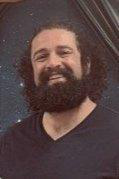
Mark Tidman I’m 32 and father to active, Neurodivergent boys. I fortunately have passed on this gene, and I am excited that I have learned how to transform what I do into a superpower. Neurodivergent students have the highest level of intelligence, yet they are under- served in almost every classroom. Learning in school, I found teachers I connected with, but none that I truly was passionate about learning from. I struggled in high school and once I got into college, I was extremely successful, not because of my teachers but because I was finally able to master the concept of self-teaching. I finished my pre-medical program and taught myself little tips and tricks along the way to graduate with a 3.8 from Biology I and II, Chemistry I and II, Organic Chemistry, Genetics Microbiology, and Anatomy I and II. I would often hold tutoring sessions for these classes and help other students in the classroom by showing them my tips and tricks on how to master and remember the content. These classes I thought I had no interest in in high school because I was not learning the appropriate way for me to absorb information. We are all born with a growth mindset, especially Neurodivergent learners. The motivating and driving factor however, is finding the correct way to learn this knowledge or an instructor you connect with.
Science Educator & Neurodivergent Advocate
Science Explorers: Discovering Chemistry, Astronomy, Biology, and Anatomy FAQ
No. Science Explorers: Conceptual Science needs no experience and no earlier Young Scholars Academy class. There is no placement test.
Yes. Mr. Mark shares real specimens on camera, from meteorite fragments and lunar samples to megalodon teeth.
Students make a prediction, watch a live demonstration, look at the evidence and explain what happened. A wrong prediction counts as evidence and leads to the next question.
The full Science Explorers sequence runs 5 to 6 semesters, about three years, before it repeats. It moves from chemistry and physics to astronomy, biology, and anatomy and medicine.
Yes. Young Scholars Academy offers Science Explorers: Conceptual Science as Enrichment or for Credit with a transcript.
That works. Students can take part in the chat as well as out loud, and cameras are optional.
Bonus bundle · Starting with Strengths
A short note from your kid's mentor every week: what they made, where they shined, what's next.
6 live expert talks for parents this spring.
A weekly friendship class, free with 3 or more classes.
5 recorded talks to watch any time.
Monday to Friday through May 28.
Live chats for parents with the YSA team.
Private Facebook group for YSA parents.
Self-paced executive function toolkit.
Summer 2027 registration opens to you 24 hours early.
Switch to a better-fit class of equal or lesser value, or take a credit toward a future class.
Total value, included with your enrollment: $5,302 ($4,693 with 1 to 2 classes)
Show Me Available Times
If you’re not 100% in love with the course, you have options depending on how you enrolled:
You can switch to another course of equal or lesser value that’s a better fit or get a credit to use toward a future course.
You can either get credit toward a future course, switch to another course of equal or lesser value that’s a better fit, or stop all future payments after a 30-day processing period.
No risk. No stress. Just the learning and belonging you have been looking for.
We can offer this because we know what we do works for thousands of other families. Kids become more self-confident. They find their people. And families tell us this is the place where their student finally feels welcome. We know it will work for your family, too.
All-Access Passes have separate terms and conditions. Please see the All-Access Pass pages.
It goes without saying, but we’ll say it anyway... to qualify for the satisfaction guarantee policy, you have to actually attend the classes. This is not a cancellation policy. It’s a satisfaction guarantee. You can’t be satisfied or dissatisfied if you don’t attend.
Young Scholars Academy is a virtual village that offers one-of-a-kind, engaging enrichment courses and community for 5-18-year-old bright, quirky kids to empower them to develop their strengths, make like-minded friends, cultivate life skills, build confidence, and feel great about themselves under the loving care of expert mentors. description2: >- Picture a place where your child fits in, is celebrated, mentored, and loves learning the unique content their beautiful brain craves. That happens every day at YSA for over 1,200+ families, and it can happen for your family, too.
WASC Accredited · 1,200+ Families · 93% Re-Enroll · 47+ States, 17 Countries, 6 Continents
Learn more about YSA Right now, a kid who thinks like your kid is in a course they chose, with a mentor who was once just like them, surrounded by friends who don't think they're weird... they think they're interesting.
Your child is one click from finding out what that feels like.

New Year Early Bird Bonuses only available until