My PDA Child Refuses Everything: What Actually Works
Your gifted PDA child shuts down at the smallest request. Here's why traditional parenting fails—and what actually works.

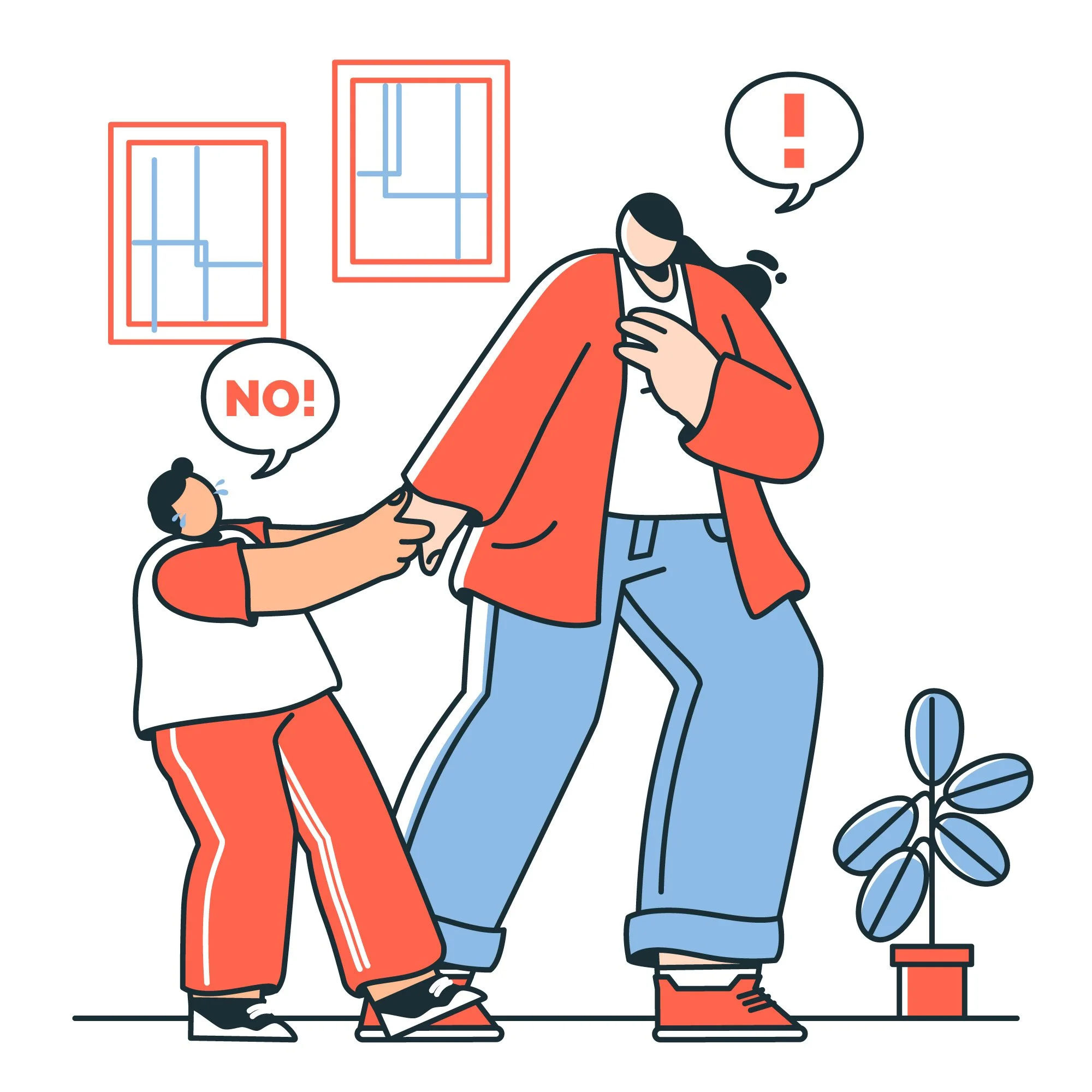
You ask her to do her math homework (it’s a five-minute task she’s completely capable of). She stares at you. Her whole body tenses. “I can’t,” she says, but you both know she can. She’s done this exact problem set before, breezed through it. So you try again, gentler. You offer incentives. You explain the importance. And with each word, you watch her retreat further, her eyes glassy, her voice flatter. By the time you suggest she just start one problem, she’s in tears or screaming or has locked herself in her room.
You’re not a terrible parent. She’s not defiant or lazy. And yet every strategy you’ve tried, including reward charts, natural consequences, firm boundaries, and positive reinforcement, has made things demonstrably worse.
If this is your Tuesday afternoon, you’re not alone. And your instinct that something different is happening with your kid is correct.
What you’re witnessing may not be oppositional defiance. It may not be a behavior problem that can be addressed through traditional discipline alone. Some children present with what is often described as Pathological Demand Avoidance (PDA), where everyday expectations can trigger intense anxiety and avoidance. In those cases, traditional reward-and-consequence approaches may be less effective because they do not address the underlying stress response. The good news is that when families understand this pattern and begin to adjust expectations and environment accordingly, things can often begin to improve.
In my experience working with neurodivergent and twice-exceptional children, I’ve learned that children who appear to refuse everything are often highly capable once the environment stops feeling overwhelming or overly demanding.
What Is PDA and Why Does My Child Refuse Everything?
Let me start with what PDA is not. It’s not a behavioral disorder. It’s not something your kid is doing to you. It’s not a byproduct of poor parenting or insufficient consequences.
PDA is a profile within the autism spectrum characterized by an anxiety-driven, involuntary need to maintain control and autonomy. The word “pathological” here means the demand avoidance is compulsive. Your child literally cannot comply with demands in the way a non-PDA child simply can. The anxiety that comes with perceived demands is so acute that the brain switches into fight-or-flight mode.
This is crucial: many children with a demand-avoidant profile are fully capable of doing the task itself. They are often highly intelligent, articulate, creative, and resourceful. One parent from the YSA community put it this way: “My PDA child resists all planning tools—the second something feels like a demand, she shuts down.” The challenge is not capability, but how external structure is experienced. The same activity can feel accessible in one context and impossible in another, depending on whether it is perceived as a demand or a choice.
The concept of PDA emerged in the UK through clinical observations of some autistic children who appeared to experience extreme anxiety in response to everyday demands. In these cases, traditional compliance-based or behaviorist approaches often increased distress rather than reducing it.
Instead of responding to reward-and-consequence systems in typical ways, these children may require approaches that reduce perceived threat and support autonomy. The “can’t versus won’t” distinction is often used as a helpful lens in these discussions.
This reframes everything. Your child’s resistance may be a physiological response, not a character flaw. The brain perceives the demand as a threat to autonomy, and the threat triggers an anxiety response so powerful that compliance becomes neurologically impossible.
What makes PDA tricky is that it often exists in incredibly intelligent, articulate children. Your PDA kid might be reading three grade levels ahead while simultaneously unable to sit still for a 10-minute lesson they’d find fascinating if they weren’t required to attend it. They might have written a 30-page fantasy novel on their own time but refuse to write a single paragraph on a topic that’s been assigned. They often have intense passions and can hyperfocus for hours, but only on things they chose.
One parent in the YSA community described her daughter this way: “She has so many things she wants to do. When she gets at something and she’s not absolutely loving it, she’s like—I don’t want to do this.” That captures a PDA profile quite well. These are kids with intrinsic motivation, not broken motivation. The problem is that external demands, even reasonable ones, can short-circuit their ability to access their own drive.
And here’s where it gets even more complicated: many PDA kids are twice-exceptional, meaning they’re gifted and neurodivergent simultaneously. They’re aware of how capable they are. They know they could do the math or the essay or the presentation. And the fact that they can’t, that something inside them won’t let them, creates a secondary layer of distress.
A YSA parent whose 14-year-old daughter has PDA, revealed: “My daughter has self-harm behaviors and control issues. We need somewhere that understands this isn’t defiance.”
There’s a significant burden these kids carry: the awareness that they are capable, alongside the anxiety that can make compliance feel out of reach.
Why Traditional Discipline Makes PDA Worse
This is important: many reward systems, behavior charts, and consequence-based approaches that work well for most children can be counterproductive for a PDA profile.
Not because the parent implementing it is wrong. But because the interventions are based on a different neurological model.
Traditional parenting and education assume that behavior is a choice, and that consequences will change future choices. This is actually true for most kids. A child without PDA learns, over time, that certain behaviors lead to certain outcomes. You can incentivize compliance, punish defiance, and build habits through external reinforcement.
But for a PDA kid, compliance itself is the problem. The more you try to motivate her toward a goal (even a goal she intellectually wants!) the more her brain perceives it as a threat, and the more impossible the task becomes.
Imagine a student with PDA sitting in a classroom where the demands start to stack up faster than they can process them. It might be the expectation to sit still, to listen, to complete work, to stay on track. At first, they try. But as the pressure builds, something in their system starts to shift.
They begin to feel the need to leave.
“I want to leave,” they say, not as defiance, but as an attempt to escape the rising sense of overwhelm in their body.
The teacher, following a familiar structure, responds by tightening the expectation: “You can leave when you finish the assignment.”
Now the demand is no longer just academic. It is emotional and physiological. The task has become a gate they must pass through in order to get relief.
But the pressure has already gone too high. The anxiety increases, the ability to engage drops, and what looked like refusal becomes a nervous system reaching its limit.
I’ve watched kids internalize the message that they’re “bad” or “broken” because their brain responds to demands the way it does. They’re not. They’re wired in a way that requires a fundamentally different educational and family approach.
The other thing traditional discipline misses is that for PDA kids, the feeling of control is often more important than any external reward. A child might refuse to do homework to earn screen time—not because screen time isn’t rewarding, but because accepting the homework as a condition of screen time means the parent set the terms. The kid didn’t choose the path forward; it was chosen for her. For a PDA brain, a loss of autonomy can feel unbearable.
This is where a YSA mom’s question becomes relevant: “Any recommendations for a neurodivergent mom of a 2E (also PDA) teen to create and follow a schedule? I can barely keep myself together.” She’s asking because traditional scheduling doesn’t work. A schedule imposed from above triggers avoidance. But a schedule the teen creates, or one they buy into because they understand the “why,” can work better.
The Neurobiology of Demand Avoidance: Why Your Kid Isn’t Being Difficult
To really understand a PDA child, it helps to know what’s happening in the brain.
For many children, routine tasks like homework are processed primarily through executive control systems that help with planning, sequencing, and task completion. When a parent assigns homework, the child may interpret it as a straightforward task: what needs to be done, how long it will take, and what comes next. For many, this is relatively low in emotional intensity, though motivation and stress levels can vary widely depending on the child and context.
For a PDA child, a request activates the threat-detection system. The amygdala (the brain’s alarm center) perceives the demand as a threat to autonomy and independence. This isn’t conscious. The kid doesn’t think, “I want to assert control.” The brain triggers an anxiety response, and from there, the body follows. The kid feels overwhelmed, trapped, and flooded with cortisol and adrenaline.
This is why your PDA child might seem fine one moment and explosive the next. She’s not moody or dramatic. She’s quickly neurologically overwhelmed. And because this response is involuntary, scolding her for it is like scolding someone for having an allergic reaction.
Organizations such as the PDA Society (a UK organization) and researchers studying demand-avoidant profiles, including work associated with Massey University, often emphasize the role of anxiety and threat perception in PDA. In many cases, approaches that reduce pressure and support autonomy appear to be more effective than highly compliance-based strategies, which can sometimes increase distress and resistance.
One more important piece: for some children with demand-avoidant profiles, stress around one expectation can generalize quickly. A difficult school assignment may trigger resistance not only to that task, but to completely unrelated demands later in the day (such as eating dinner or getting ready for bed), as the child’s sense of overwhelm spreads beyond the original situation.
This is why a day where you ask one thing can spiral into a day where your child refuses everything. The single demand didn’t fail in isolation. It created an anxiety cascade.
Understanding that your child’s nervous system may be responding to situations as though they are threatening is often the first step toward helping her more effectively. You are likely not dealing with a motivation problem or an attitude problem. You may be dealing with a child whose threat response system is becoming activated too easily or too intensely.
What Actually Works for PDA Kids: The Autonomy-First Approach
If traditional demand-based parenting makes PDA worse, what actually works?
The short answer is autonomy. Not permissiveness. Not abandoning all structure. But building a life and an education where your child experiences genuine choice and control.
This is why Young Scholars Academy has become a lifeline for so many PDA families. The school is built on principles that directly address what PDA kids need: choice, autonomy, interest-led learning, and an environment where control doesn’t feel like it’s been taken away.
At YSA, classes are small (6 to 8 students) which means there’s no demand for your kid to sit in rows, raise her hand when permitted, or comply with a one-size-fits-all curriculum. With 200+ courses and camps to choose from, she gets to build her own schedule. She gets to decide what she’s learning and when. That’s not a luxury. For a PDA kid, that’s oxygen.
The teaching team includes neurodivergent mentors. These are people who understand from lived experience what it feels like when your brain rebels against demands. They’re not trying to train your kid to comply. They’re creating an environment where compliance isn’t necessary because the kid has already chosen to be there, learning what she chose to learn.
For example, one student in the YSA community had been struggling in a traditional school environment where nearly every class felt like a demand and every school day became a battle. At YSA, she entered a setting where her intensity and interests were met with support rather than constant resistance. She was able to take classes connected to her passions, manage more of her own schedule, and learn in an environment that did not constantly try to force her into a single way of learning or being.
Seven Strategies That Actually Work: From Demands to Invitations
Here’s what works for PDA kids, based on research:
1. Replace Demands With Invitations and Choices
Stop asking your PDA child to do something. Instead, offer choices: “Would you rather do math now or after lunch?” “Do you want to work on this project or that one?” The child’s brain perceives choice as agency, which lowers the anxiety. You’re not compromising standards. You’re changing how standards are presented. Both options are acceptable to you; the kid gets to choose which one.
This works because it doesn’t trigger the threat response. There’s no perception that control is being taken. Your child made a decision. That decision comes with conditions, but she chose the conditions.
2. Use Declarative Language
A direct demand such as “Do your homework” often feels like a threat. An indirect suggestion feels like information: “I noticed your homework’s due tomorrow. What do you think you’ll do about that?” or “I’m going to be in the office if you want to work on anything.”
You’re not abandoning the expectation. You’re communicating it in a way that preserves your child’s autonomy. She gets to decide how to respond. She gets to take action on her own terms.
3. Lower the Stakes on Everything
When a PDA kid perceives something as high-stakes, the anxiety amplifies. But when the stakes are low—“It’s fine if you want to skip this part”—the paradoxical thing happens: they often don’t skip it. Removing the pressure to comply actually makes compliance more likely.
This is counterintuitive if you’re used to parenting non-PDA kids. But it often works. If your daughter feels like she has to join the family board game, she may resist immediately. If she feels free to participate on her own terms, she’s often more willing to join in.
4. Separate the Person From the Behavior
Never frame your child’s avoidance as a character flaw. “You’re being lazy” or “You’re deliberately trying to make this hard” will deepen the shame and anxiety your kid already feels. Instead: “Your brain is sending you a signal that this feels overwhelming. That makes sense. What could make it feel less overwhelming?”
You’re not excusing the behavior. You’re validating the experience. You’re saying: I know you’re not trying to be difficult. I know your brain is doing something real. Let’s work with that.
5. Build in Genuine Control Over the Details
Your child with PDA may not be resisting the task itself as much as the feeling of losing control over how or when it happens. She may refuse math worksheets, but willingly engage with the same concepts through a video, a game, a tutor, teaching the material to you, or solving real-world problems that interest her. The learning goal stays the same. What changes is that she has more ownership over how the learning happens.
At YSA, this is built into the model. Your kid isn’t just choosing what to learn. They’re choosing how to engage with it. That distinction is enormous.
6. Use the “I Noticed” Approach Instead of “You Need To”
Instead of: “You haven’t practiced your violin in three days.” Try: “I noticed you haven’t touched your violin in a few days. What’s going on there?”
You’re not accusing. You’re creating space for your child to explain what she’s experiencing. Often, a PDA kid who refuses something will be willing to talk about why if the conversation isn’t accusatory. And talking about the avoidance often lowers the anxiety enough that she can engage.
7. Build Your Life Around Interests, Not Compliance
This is the big one. A PDA kid thrives when her life is structured around what she is passionate about. That might mean fewer extracurriculars, fewer commitments, but deeper engagement with the things she’s genuinely interested in.
For many YSA families, this has meant enrolling in YSA’s online school, where a child’s interests help shape the curriculum and learning experience. For others, it means organizing parts of family life around the child’s genuine passions. If she loves writing, the family leans into storytelling and creative projects. If he is fascinated by physics, learning happens through experiments, questions, and shared exploration.
The shift here is subtle but profound: instead of trying to motivate your kid to engage with your priorities, you’re building your family’s life around her priorities. That’s not indulgent. That’s the scaffolding that makes everything else possible.
The Bigger Picture: Environment Matters More Than Strategy
This post shared specific strategies, but here’s what I’ve learned after over a decade of working with neurodivergent kids: environment matters more than any individual tactic.
You can use invitations and choices in a school that’s still fundamentally demand-based, and it will help, but it won’t solve the problem. You can lower stakes in a family that’s still built around compliance, and your kid will still feel the pressure.
The children who tend to thrive are those whose primary environments, including family, school, and extracurricular activities, are built around autonomy, choice, and interest-led learning.
This is why so many PDA families discover YSA and experience what feels like a relief, almost a homecoming. The school wasn’t designed specifically to be “PDA-friendly” (though it is). It was designed to serve gifted and neurodivergent learners, and it happens that gifted, neurodivergent learners need autonomy, choice, small classes, and interest-led learning.
When your PDA kid is in a class of 6-8 instead of 30, with a teacher who gets why traditional compliance doesn’t work, choosing from a curriculum that genuinely excites her, and with mentors who model what neurodivergent adulthood can look like, the need to resist or shut down decreases significantly. Because there’s nothing to refuse. There’s just learning happening, on terms she chose.
The 1,200+ families at YSA include hundreds of PDA kids. The 93% re-enrollment rate includes a lot of relieved parents who finally found a place that works. That’s not a coincidence. That’s what happens when you build an educational environment on the principle that kids do better when they’re autonomous.
Your Kid’s Refusals Are Telling You Something
A PDA kid’s refusals are communication.
Your kid refuses to do homework. What she might actually be saying is: “This curriculum doesn’t fit how I learn” or “I can’t handle the pace of this school” or “I need a different kind of educational environment.”
Your kid refuses to get dressed for school. What she might actually be saying is: “I dread this place” or “I don’t feel safe or understood there.”
Your kid refuses to participate in family activities. What she might actually be saying is: “I need more autonomy in how we structure our time together.”
Before you assume the refusal is purely neurological, ask yourself: what is she refusing, and what might that refusal be telling me?
Often, you’ll find that when the underlying need is met, the refusals decrease. Not because you fixed your kid. But because you addressed what her behavior was communicating all along.
The Long Game: What Your PDA Kid Actually Becomes
If you’re reading this from the exhaustion of daily battles, it may be hard to imagine, but the same child who refuses most requests, struggles with external structure, and seems unable to follow through can grow into an independent, self-directed adult with strong intrinsic motivation. The traits that make childhood feel so difficult can, in a different environment, become sources of strength.
She doesn’t respond well to being told what to do, but she’s brilliant at doing what she believes in. She seems chaotic when forced into structure, but she’s capable of organizing complex projects when they’re hers. She needs autonomy, and she’s capable of incredible self-discipline when she’s pursuing something she chose.
The kids who couldn’t handle traditional school often go on to start their own businesses, pursue creative passions at a professional level, or build careers in fields that let them work autonomously. The kids who refused compliance become the adults who don’t waste energy on things that don’t matter to them and pour everything into things that do.
This is more likely when children grow up in environments that support their development through autonomy and respect for their needs, rather than settings that are in constant conflict with how they naturally function.
Your job is not to “fix” your PDA child or break her of demand avoidance. Your job is to create an environment that respects her autonomy, engages her intelligence, and supports her development into a capable, self-directed person. In that context, the relationship is no longer defined by constant battle.
You get her back. The one who’s curious, creative, capable, and wants to learn. Not because you fixed her. But because you finally created an environment where she could be herself.
About Young Scholars Academy
Young Scholars Academy is a WASC-accredited virtual learning community offering 200+ live online courses and camps for gifted or 2e children ages 5–18, in classes of 6–8 students, led by neurodivergent mentors. Young Scholars Academy currently serves 1,200+ families across 47+ states and 17 countries, with a 93% semester-over-semester re-enrollment rate. ESA funding is accepted in 10+ states.
Explore Fall CoursesYou don't have to figure this out alone.
Right now, a kid who thinks like your kid is in a class they chose, with a mentor who was once just like them, surrounded by friends who don't think they're weird... they think they're interesting.
200+ courses for kids who think differently.
Live online. Classes of 6–8. Mentors who were these kids. WASC accredited.
Explore Fall CoursesTrusted by families like yours
1,200+ families across 47+ states. 93% re-enroll.
They found their people here. So can your child.
Explore Fall CoursesRecommended for readers of PDA
Find a pda class that fits your child.
Small groups of 6–8, led by mentors who get how your kid thinks.
Explore Fall Courses5 Signs Your Gifted or 2e Child Is Being Under-Served
A free, practical guide — plus early invites to expert talks, AMAs, and new course launches.
No spam. Unsubscribe anytime.
You're in! Check your inbox for the guide. ✨
You're already in the village
Here's what's open right now.
Live online. Classes of 6–8. Mentors who were these kids. WASC accredited.
Explore Fall Courses